Sociology, Anthropology, and Power
in the Age of Synthetic and Sovereign Stacks
Power is not “who’s in charge.” It is infrastructure: institutions that script behavior, class control over risk and time, symbolic orders that define the real, and the continuous work that maintains a universe of plausibility.




0. Orientation: What “Power” Really Means Here
This module treats power as infrastructure:
- Power as institutions that script behavior.
- Power as class and control over resources, time, and risk.
- Power as symbolic order that defines what’s real, normal, or insane.
- Power as social construction and universe-maintenance.
- Power as everyday resistance—and its capture.
Sovereign Stack Bitcoin-native • decentralized • symbolic+material infrastructure for autonomy • voluntary order • resistance to capture.
1. Power as Ontological Infrastructure
Power is not only “who’s in charge.” It is:
- Ontological: deciding what counts as real and possible.
- Temporal: deciding whose time is owned, wasted, accelerated, or frozen.
- Somatic: deciding which bodies are protected, exploited, or discarded.
- Symbolic: deciding which stories, categories, and roles are legitimate.
2. Institutions & Biopower: How Structures Govern Life
2.1 Weber — Domination Types, Bureaucracy, Protocol-Cages R01 Yale R02 Iron Cage
Weber’s triad of domination: traditional, charismatic, legal-rational. Modern states and corporations are built on legal-rational domination: hierarchies, written rules, predictable procedures. The “iron cage” is rational-legal governance becoming inescapable.
Synthetic stack view: bureaucracy evolves into protocol domination: “the system decided,” “the algorithm flagged it,” “the rules require it.”
Yale SOCY 151 — Lecture 17: Conceptual Foundations (authority/domination)
VideoYale SOCY 151 — Lecture 20: Weber on Legal-Rational Authority (bureaucracy)
VideoSocial Science Bites — Peter Ghosh on Max Weber & the Protestant Ethic
AudioWeber — “Politics as a Vocation” (text reference)
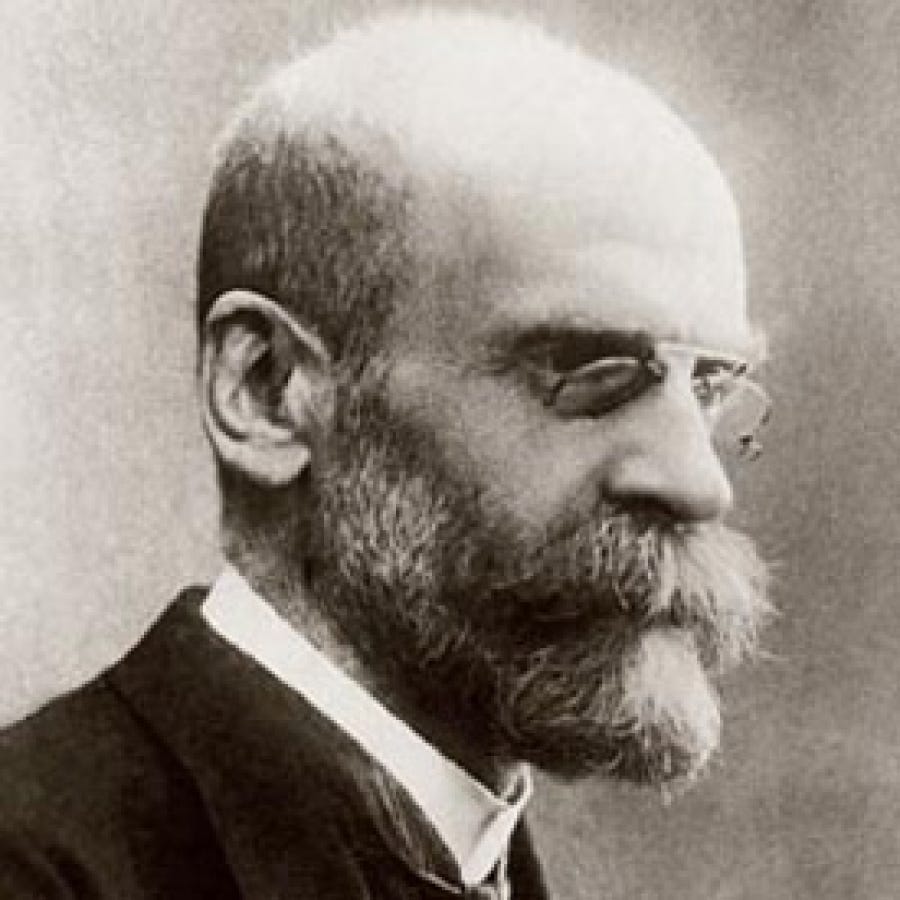
Text2.2 Durkheim — Social Facts, Solidarity, Anomie R07 Yale R08 Lukes
Durkheim’s social facts are external, coercive, shared. He distinguishes mechanical solidarity (sameness) and organic solidarity (interdependence). When regulation fails: anomie (normlessness, meaning collapse).
Synthetic stack view: social facts become platform policies, regulatory codes, “accepted narratives,” and data categories. Sacred/profane splits get recoded into safety, security, progress, and deviance labels.
2.3 Berger & Luckmann — Construction, Legitimation, Universe-Maintenance R11 SCR R12 Vera
Reality is assembled via: externalization (people create patterns), objectivation (patterns crystallize as “things out there”), internalization (new generations treat them as natural). Legitimation supplies the “why”; universe-maintenance keeps the symbolic world intact; plausibility structures make beliefs feel credible.
Synthetic stack view: universe-maintenance becomes education/media/platform ecosystems; plausibility structures are HR, credentialing, and feed curation. Parallel sovereign worlds must contend with the fact that most plausibility infrastructure belongs to the synthetic regime.
Berger & Luckmann — The Social Construction of Reality (text reference)
TextHéctor Vera (2016) — “Rebuilding a Classic: The Social Construction of Reality at 50”
Paper“Social Construction of Reality at 50” (talk hub)
VideoPlausibility structures (mapping hub)
Hub2.4 Goffman — Dramaturgy, Total Institutions, Mortification, Stigma R14 Lunt R17 Stigma
Social life is dramaturgy: frontstage performance, backstage preparation and frankness. Total institutions (prisons, asylums, barracks) collapse life into a single authority and mortify the self: uniforming, numbering, stripping possessions, re-scripting identity. Stigma marks “spoiled identity” and forces impression management.
Synthetic stack view: frontstage expands (social media, surveillance, quantification), backstage shrinks (continuous visibility). Total institutions become distributed: ID systems, financial access gates, reputational scoring. Stigma becomes infrastructural.
2.5 Scott — Legibility, High-Modernism, Colonial Labs R20 SLAS R18 Lecture
States seek legibility: standardized names, maps, titles, censuses, categories. Local mētis (practical know-how) is flattened into administrable forms. High-modernism is the expert confidence that societies can be redesigned from above. Colonial/racialized contexts functioned as labs for ID systems, pass laws, land reforms, and population management.
Synthetic stack view: legibility expands into biometrics, geolocation, CBDC tracing, health/genetic data, ESG/risk scoring. High-modernism mutates into AI-driven social engineering and smart-city regime design.
2.6 Biopower: Governing Bodies and Life Processes
Institutions regulate birth, death, health, disability, sexuality, productivity, aging. Schools, hospitals, welfare offices, asylums, prisons, and militaries treat bodies as objects of classification, discipline, and optimization.
Synthetic stack view: biopower becomes pharma–public entanglement, algorithmic triage, health passports, compliance metrics, insurance/risk modeling used to justify intervention or exclusion.
3. Class, Labor, and Temporal Sovereignty
3.1 Weber — Class, Status, Party, and Force R02 Weber
Weber models stratification as overlapping power bases: class (market position/life chances), status (social honor), party (organized power influence). State violence backs the regime: courts, police, military, prisons.
Synthetic stack view: class is access to liquidity/credit; status is institutional respectability and credentialed legitimacy; party is the coalition layer (states/corporations/foundations/NGOs) aligning policy, infrastructure, and narrative.
3.2 Bourdieu — Capital, Field, Habitus, Reproduction R24 Film
Fields are structured arenas of struggle; capital (economic/cultural/social/symbolic) is convertible power; habitus is embodied disposition tuned to dominant fields. Symbolic violence occurs when dominated groups misrecognize domination as natural.
Inside bitcoin/sovereign worlds: capital converts into coin holdings, technical mastery, networks, and symbolic status. New aristocracies can form behind different aesthetics.
Bourdieu — The State Nobility (text reference)
TextBourdieu — Language and Symbolic Power (text reference)
TextPierre Bourdieu (bio/context)
Context3.3 Graeber — Debt, Labour, Surplus Populations R34 Debt
Debt is a moral relationship before it is finance. Debtors are cast as obligated and controllable; debt systems historically require violence and shame rituals. “Bullshit jobs” persist because they preserve hierarchies, dependency, and institutional inertia. Automation produces surplus populations managed for stability rather than needed for production.
Graeber — Debt: The First 5,000 Years (official book page)
TextGraeber — The Utopia of Rules (text reference)
TextGraeber — Bullshit Jobs (text reference)
TextGraeber — talks/lectures hub (Collège de France + archives)
Hub3.4 Reproductive Labor and Care
Class is not only wages and portfolios. It includes who performs child care, eldercare, emotional support, and domestic work, and whose bodies/time are demanded to sustain others. If care remains invisible, new hierarchies reappear inside any stack.
3.5 Temporal Sovereignty
Beyond money and work is time: who sets schedules, deadlines, and rhythms; who lives in chronic urgency; who has reflection, recovery, and long horizons. Synthetic systems compress time (24/7 platforms, real-time data, rapid policy cycles), depriving lag needed for autonomy and critical thought.
4. Symbolic Power, Narrative Sovereignty, and the Body
4.1 Durkheim — Sacred/Profane in Modern Dress R08 Lukes
Sacred values become justification engines. Profane categories become discard labels. Symbolic power decides which topics may be questioned and which groups may speak. Synthetic symbolic order uses sacred values to justify censorship, exclusion, surveillance, and punishment.
4.2 Bourdieu — Doxa, Symbolic Violence, Somatic Imprint R27 LSP
Doxa is the invisible background assumption layer (“of course everything should be digital,” “of course safety outranks privacy”). Symbolic violence succeeds when people adopt doxa that harms them. This is somatic: tightness around authority, automatic deference, chronic shame and anxiety.
4.3 Goffman — Stigma and Categories of Exclusion R17 Stigma
Labels (“risky,” “non-compliant,” “criminal,” “unbanked,” “misinformation”) do not merely describe. They redefine a person as a walking risk category, justify special treatment, and collapse individuality into a threat template. In datafied systems stigma becomes automated: scores, watchlists, reputational gating.
4.4 Platforms, Media, Education as Symbolic Machinery
Platform policies, UI/UX friction, search ranking, curricula, credentialing: these are hardware for doxa. They encode views of human nature, governance, economy, history.
4.5 Graeber — War on Imagination R36 Rules
Bureaucracy and corporate culture erode imagination: alternatives feel childish or insane. Symbolic power at its peak makes exit feel implausible.
5. Social Construction, Anthropology, and Ontology War
5.1 Worlds, Frames, Plausibility Structures R11 SCR R15 Frames
If reality is socially constructed, there are competing world-builds. Frames answer: “what is going on here?” Whoever controls the frame controls which actions are allowed or required. Synthetic regimes deploy emergency frames (health, disinformation, climate, security) to enforce compliance.
5.2 Simmel — Forms, Money, Metropolis R28 Text R30 Aeon
Forms of interaction persist while content changes (conflict, exchange, secrecy, subordination, sociability). Money abstracts value and can flatten qualitative relations into numbers. The metropolis overloads with stimuli; the blasé attitude becomes defense; emotional distance becomes normal.
Synthetic extension: global metropolises of attention; endless stimuli; numbness and outrage alternating as regulated emotional states. Hard money intensifies abstraction (pure number) while grounding in irreversible time sacrifice; meaning depends on surrounding symbolic/moral frames.
5.3 Anthropology as Method: Estrangement, Margins, Multiplicity
Anthropology goes to margins (peasants, indigenous, informal economies, ritual specialists), treats their worlds as equally real, and makes “our” institutions look strange. It reveals contingency: markets not universal; states historically specific; money can be shells or tally sticks; law can be customary and oral.
5.4 Ontology War: Competing Universes
Synthetic stacks are universe-maintenance regimes insisting there is one rational, safe, progressive arrangement. Sovereign projects are competing ontologies: different answers to what a person is, what time/value are, and what counts as legitimate authority.
6. Everyday Resistance, Co-optation, and Prefiguration
6.1 Scott — Weapons of the Weak, Hidden Transcripts R21 WoW R22 H.T.
Public transcript (outward compliance) vs hidden transcript (backstage critique). Weapons of the weak: foot-dragging, evasion, sabotage, informal economies and mētis persisting under schemes of control.
Synthetic twist: digital resistance becomes data; systems learn and update repression strategies.
6.2 Co-optation and Counter-Insurgency
Resistance patterns are observed then monetized, politicized (controlled opposition), criminalized (selective enforcement), and narratively inverted (“extremism,” “misinformation”). Counter-insurgency penetrates networks, manufactures distrust, and offers safe system-friendly substitutes.
6.3 Mauss — Gift, Obligation, Patronage R32 Gift
The gift creates obligation and ongoing relationship; giving/receiving/reciprocating are moral duties. Gifts can build solidarity or embed patronage. In sovereign networks mutual aid is crucial but can also create hidden hierarchies and quiet rulers.
Mauss — The Gift (HAU Books open edition)
TextMauss — The Gift (text reference)
ContextAid/development as hierarchical gifting (entry search)
SearchGraeber ↔ Mauss (bridge search)
Bridge6.4 Graeber — Direct Action and Prefigurative Worlds
Direct action acts as if illegitimate powers do not exist; solves problems directly; builds horizontal organizations. Prefiguration embeds alternative infrastructure: parallel schools, markets, dispute resolution, welfare arrangements.
6.5 Differential Risk, Burnout, and Marginalized Bodies
Resistance costs are uneven: dependent children, illness/disability, poverty, legal precarity magnify exposure. Long-horizon resistance strains health, produces fragmentation, and can devolve into self-destruction. Any serious model must account for differential risk distribution.
7. Recursive Power Systems and Sovereign Design Fault Lines
Power is recursive:
- Institutions shape who gets capital and status.
- Class shapes who controls institutions and infrastructure.
- Symbolic orders justify institutions/class and supply categories for thought.
- Bodies/nervous systems are conditioned by these structures, reinforcing compliance or resistance.
- Technology and time regimes reinforce habits and infrastructure.
- Resistance feeds back as learning data for systems or seeds new structures.
- Weberian trap: protocol iron cage (no override of unjust behavior).
- Durkheimian trap: cult hardening + internal persecution; anomie for those who can’t keep up.
- Bourdieu trap: new aristocracies via capital conversion and distinction.
- Scott trap: high-modernist sovereignty (schemes that erase local knowledge).
- Mauss/Graeber trap: patronage chains hiding as “community.”
- Biopolitical trap: body neglect or new health dogmas.
- Temporal trap: reproducing acceleration/burnout.
8. Meta-Capture: How This Lecture Can Be Turned
- As edutainment (interesting knowledge with no consequences).
- As cultural capital (signaling sophistication / gatekeeping).
- As ego armor (“I understand power, so I’m immune”).
Reflexivity is non-optional: analyst, student, and designer remain inside the system being analyzed.
9. Closing: What This Module Delivers
Classic sociology/anthropology becomes a schematic for how synthetic stacks assemble and maintain domination (bureaucracy → protocol power; social facts → sacred narratives; universe-maintenance → media/education/platforms; fields/capital → elite reproduction; dramaturgy/stigma → identity governance; legibility → smart-city/CBDC planning; gifts/debt → obligation; direct action → cracks for alternatives).
Resource Index
IDs below match in-lecture chips (e.g., R02).
- L01 Sociology Central — links hub ↗
- L02 Steven Lukes on Durkheim (Social Science Space) ↗
- L03 Mapping Social Theory (unimelb) ↗
- L04 Icarus Films — Sociology is a Martial Art ↗
- L05 Peter Lunt on Erving Goffman (Social Science Space) ↗
- L06 Scott — A Golden Age of Barbarians? (YouTube) ↗
- L07 Scott — Deep History of State Evasion (YouTube) ↗
- L08 Sociology Is a Martial Art (IMDb) ↗
- L09 YouTube link (as received) ↗
- L10 Social Science Bites — Peter Lunt on Goffman (Libsyn) ↗